|
 |
 |
 |
| |
|
Getting your fill of gyros
June 2, 2006 - Chicago has one of the largest Greek populations
in the country, but there's much more to the food culture than just
flaming cheese. Gyros are also big business. All of the major gyro
meat manufacturers are based in Chicago and ABC7's Hungry Hound
has been exploring the local gyros scene recently.
Gyros come from the word "gyro," which means to rotate.
In Chicago, you'll find the giant, lamb and beef cones rotating
on vertical spits year-round. The U.S. Market for gyros is now in
the neighborhood of $250 million a year-- all of it coming from
Chicago manufacturers. It's pretty clear in a city of Italian beef,
deep dish and hot dogs, we sure love our gyros too.
In Greektown, you can find gyros just about everywhere. But few
are better than those at The Parthenon, where, for the past 30 years,
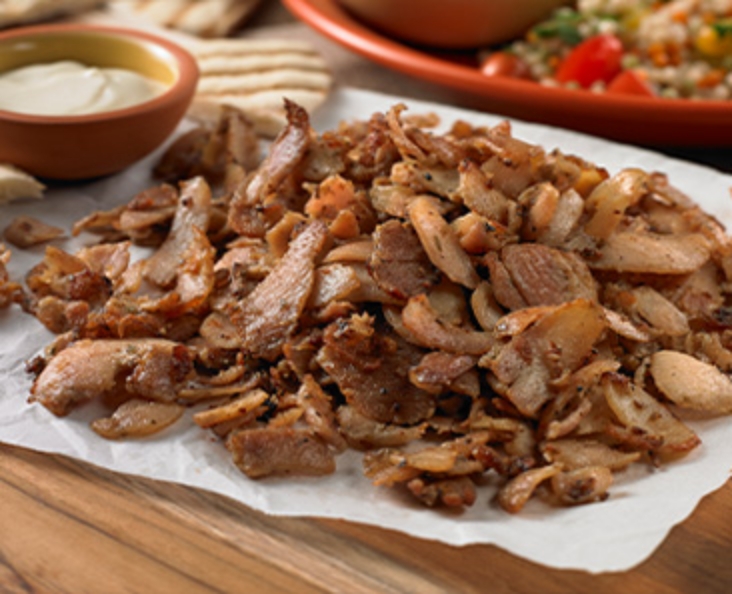
they've been making them by hand everyday. Large discs of ground
beef and lamb are alternately layered with fat, then trimmed to
fit a customized vertical spit. Once the outer layer is nicely browned,
they're sliced and plated atop pita with onions, tomatoes and chunky
tzatziki sauce, made from cucumbers and yogurt.
Since 1975, Kronos has been working to spread the gyros gospel all
over the country. From its main plant on the city's Southwest Side,
they crank out enough gyros to make 250-thousand sandwiches a day
- nearly half are destined for Chicago stomachs. The recipe hasn't
changed much in 30 years.
"A gyro is a blend of lamb and choice beef with Greek spices
like Oregano," said Pat Costello, Kronos President, C.E.O.
A ratio of 80 percent beef to 20 percent lamb, actually...then breadcrumbs
and spices are mixed in, until the combo is forced into cylindrical
molds. The edges are trimmed off, and they're packaged for shipment
all over the country. Along with its pitas and tzatziki sauce, Kronos
does about 80 million dollars' worth of business each year.
One of their best customers is Dengeos in Skokie and Buffalo Grove.
The Skokie location sells more than 200 sandwiches a day. They used
to make it themselves, but as demand increased, they started buying
from Kronos.
"Started making it here homemade in 1972 and it was a combination
of beef and lamb - 80 percent beef, 20 percent lamb and just cook
to order, freshly-sliced onions and tomatoes and homemade sauce,
most popular sandwich here in Chicago," said Nick Theodosis,
Dengeos.
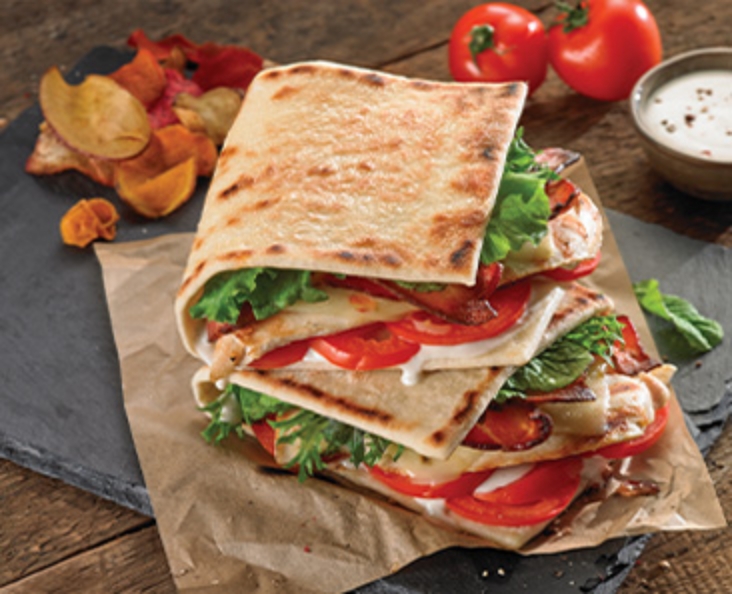
The gyros come either on a "plate" with the necessary
extras, or in a sandwich, all rolled up in a grilled pita. Theodosis
prides himself on the homemade tzatziki.
"It's yogurt, sour cream with a little bit of spices, lemon
juice and cucumbers." Gyros may never reach the level of popularity
as the Chicago Dog or deep dish pizza.. but Greek entrepreneurs
say demand shows no signs of slowing down. "Been serving it
for thirty years...very popular, great sandwich."
Kronos is not alone. Elk Grove Village's Grecian Delights, Bensenville's
Corfu and Olympia Foods on the Southwest Side are all busy cranking
out not only gyros, but also pitas and tzatziki. Rare is the joint
that has the resources and manpower to make their own, such as the
Parthenon.
The Parthenon
314 S. Halsted
312-726-2407
Dengeos
3301 W. Main St., Skokie
847-677-7911
195 W. Dundee Rd., Buffalo Grove
847-520-0004
Nick's Drive In
7216 N. Harlem Ave.
773-631-5045
Kronos Products (to find out where they're sold)
800-621-0099
Link to:
http://abclocal.go.com/wls/story?section=restaurants&id=4230821
|
|
From the Crain's Chicago Business Newsroom
5/17/2006
By Gregory Meyer
Kronos Foods buys nation's largest baklava baker
(Crain's) - Chicago's largest gyros meat maker has acquired the
nation's top baklava baker.
Kronos Foods Inc., which specializes in Greek cuisine including
gyros sandwiches, bought Rain Creek Baking Co. of Fresno, Calif.
for an undisclosed sum.
Kronos, with about $75 million in annual revenues, has since 2004
been owned by Prospect Partners LLC, a Chicago private-equity firm.
Prospect generally seeks to invest in companies with revenues between
$10 million and $30 million, a spokeswoman said.
Rain Creek's products including baklava and other pastries sold
under the Sinbad Sweets, Michael's and Rain Creek brands.
"Rain Creek is a synergistic fit for Kronos," said Kronos
Foods CEO Michael Austin, in a statement Tuesday. "By marrying
Rain Creek's strong retail presence with Kronos's strong foodservice
presence, we can now offer a broader product line to more food outlets
in more places - and reach many more people with both classic and
modernized Mediterranean foods."
Link to:
http://chicagobusiness.com/cgi-bin/news.pl?id=20645&bt=kronos&arc=n&search |
|
Published in Crain's Chicago Business
12/19/2005
By Gregory Meyer
New spin for gyros
Makers of Greek fast food aim to broaden its appeal: Whole Foods,
ballparks and beyond.
Can the gyro be the next bratwurst?
The major makers of the Greek fast-food staple, all based in Chicago,
would like to emulate the rise of the German sausage from regional
ethnic specialty to culinary commonplace, available everywhere from
football stadiums to some McDonald's restaurants.
Local gyro makers are banking on new products and marketing to make
the leap from hot dog places - where most gyros are now sold - into
far-flung restaurant chains, convenience stores, ballparks and even
the carving stations at a high-end grocery chain.
The ultimate aim: Jump-start a stagnant U.S. market estimated at
$250 million a year.
Elk Grove Village-based Grecian Delight Foods Inc. is test-marketing
hormone- and additive-free gyros at Whole Foods Market stores in
Columbus, Ohio, and Reston, Va. Among other new customers: the Daphne's
Greek Café and My Big Fat Greek Restaurant chains in the
West.
Grecian Delight rival Kronos Foods Inc. of Chicago has hired its
first chief marketing officer: Alan Willner, a Pabst Brewing Co.
veteran who gave the old beer brand new hipster appeal by giving
it away at bike messenger rallies and art openings. Mr. Willner
wants to see gyros sold at Wrigley Field or in precooked form at
the local White Hen, and is thinking about revamping Kronos' ubiquitous
"gyros girl" poster.
"When we go to replace it, we're probably going to have a backlash,"
Michael Austin, Kronos' new CEO, says only half-jokingly. A Kronos
spokeswoman says the company has about $75 million in annual sales,
half from gyros.
"Repositioning" gyros may take more than reworking a poster,
however. Another challenge will be appealing to increasingly health-conscious
consumers.
The gyro "doesn't have a healthy halo," says Bob Goldin,
executive vice-president of Chicago-based food industry research
firm Technomic
Inc.
Chicago is home to all five major gyro meat makers - a result of
demographics as well as individual enterprise. "Chicago really
is the gyro manufacturing capital of the country," says Grecian
Delight's CEO, Stan Greanias, who reports revenues of $60 million,
half from gyros.
Illinois trails only New York and California in residents of Greek
ancestry, according to the Census Bureau, making it a premier market.
In the 1970s, some local entrepreneurs began innovating on the gyro
(a word meaning "rotate" in Greek), then handmade in local
Greek restaurants.
Among the first was Peter Parthenis Sr., an immigrant and University
of Illinois engineering graduate who designed the Autodoner vertical
broiler. He started mass-producing gyro meat in 1972 after seeing
restaurateurs struggle to prepare it themselves.
"The first meat cone that we sent out of state was on a Greyhound
bus," says Mr. Parthenis, 60. His company became Grecian Delight,
where he is now chairman.
In 1975, Chris Tomaras founded Kronos to manufacture his own broiler,
the Kronomatic. Until selling the company in 1994, he was his own
marketing chief, picking point-of-sale materials from table tents
to pita wrapping to get operators excited about the gyro. He also
picked the first Kronos poster model, a blonde.
"The idea was to not have a Greek-looking girl, but an American
girl," says Mr. Tomaras, 68. "And it worked. It worked
by Americanizing the product."
Two other gyro producers in the Chicago area are Corfu Foods Inc.
of Bensenville and Olympia Food Industries Inc., based on Chicago's
Southwest Side. All but Kronos are still owned or run by Greek-Americans.
Corfu, whose sales Technomic's Mr. Goldin estimates at about $25
million, did not return calls. Olympia dates to a Sheridan Road
restaurant that President Andre Papantoniou opened with his brother
in 1971. He says it evolved into a pita company and later started
making gyros, which now constitute about half Olympia's roughly
$30 million in sales.
Kronos, bought in 2004 by Chicago private-equity firm Prospect Partners
LLC, is looking to push beyond food-service channels into grocery,
warehouse club and convenience stores.
Meanwhile, Devanco Foods Inc. of Elk Grove Village, with $20 million
in sales, this year followed other players by introducing a gyro
product that conforms to halal, the Islamic dietary code. Next year,
Devanco plans to roll out products "that are going to be perceived
as healthier and more mainstream than gyros," says CEO Peter
Bartzis. He won't give details, but calls the products in development
"revolutionary."
Link to:
http://chicagobusiness.com/cgi-bin/mag/article.pl?article_id=25057 |
|
A Web-only article from ChicagoBusiness.com
11/09/2005
By Gregory Meyer
The Hero Of Gyros
Spotlight: Michael Austin
Job: Chief executive, Kronos Foods, Inc., a Chicago-based Greek
food company that is the nation's top purveyor of gyros meats, since
last week.>
Vitals: 57 years old; bachelor's degree in political science, University
of North Carolina, 1970. His 35-year food career has taken him to
Oscar Mayer & Co., Ore Ida Foods, Sysco Corp., Kraft Foods Inc.'s
foodservice unit and Atlanta Foods International. Most recently
he ran Gourmand Specialty Foods Inc., a Virginia-based importer
and distributor of high-end foods like foie gras, caviar and fine
olive oil.>
Strong suit: Sales and marketing to large food customers like institutions
and restaurants.
Résumé gap: No experience in the Greek food niche.
Kronos, with about $100 million in sales, also makes pita bread,
tzatziki sauce, spanakopita and desserts.
Track record: At Gourmand, he shepherded the luxury foods company
to a sale after a dramatic downturn in expense account budgets hurt
the company in the early 2000s. "We exited the business gracefully,"
he says. Gourmand was owned by Prospect Partners LLC, a Chicago-based
private equity firm that acquired Kronos in 2004.
Job one: For consumers who know the Kronos brand, it's probably
through association with dated posters on the walls of hot dog stands
in Chicago and New York depicting a woman biting into a gyro sandwich
above the words, "Hungry for something different?" Having
just hired a chief marketing officer, Mr. Austin wants to test brand
awareness over the next six months and come out with "some
fresh designs, some fresh logos, some fresh point-of-service material.
We will see Kronos moving into the marketplace with a new, brighter,
polished image."
Obstacles: Flashy marketing may not be enough to draw customers
concerned about gyros' healthfulness. "I think Greek food has
a connotation of being 'junk' food," says Bob Goldin, executive
vice-president of Technomic Inc., a food consultancy. "It hasn't
really capitalized on some of the healthy halo of other Mediterranean
foods."
The plan: Innovation. For example, the company has introduced a
chicken strip as an alternative to the heated cones of beef trimmings
and lamb that fill traditional American gyros.
Link to:
http://chicagobusiness.com/cgi-bin/news.pl?id=18449&bt=The+Hero+of+Gyros&arc=n&searchType=all |
|
 |